Pasadena Housing, Homelessness & Planning Committee Revisits Encampment Policies
At this months meeting of the Housing, Homelessness and Planning Committee, the agenda included an informational item on policies related to homeless encampments. Jason Mikaelian, Deputy Director of Planning Department, explained to the committee that the staff were bringing this forward due to increased reports from concerned residents about unhoused people congregating in spaces like schools and parks in their neighborhoods. From the staff report:
"This report is informational only. The Housing, Homelessness, and Planning Committee may discuss and provide direction to staff regarding any further work related to homeless encampments."
This was listed only as an informational item and simply a review of the anti-camping policies of Glendale, Santa Ana and Los Angeles. However, the fact that Pasadena could be considering ramping up enforcement of code provisions covering sleeping on public properties while there is currently no year-round emergency shelter options in Pasadena (i.e. nowhere for people to go!) is very alarming.
How does Pasadena currently respond to encampments
From the staff report:
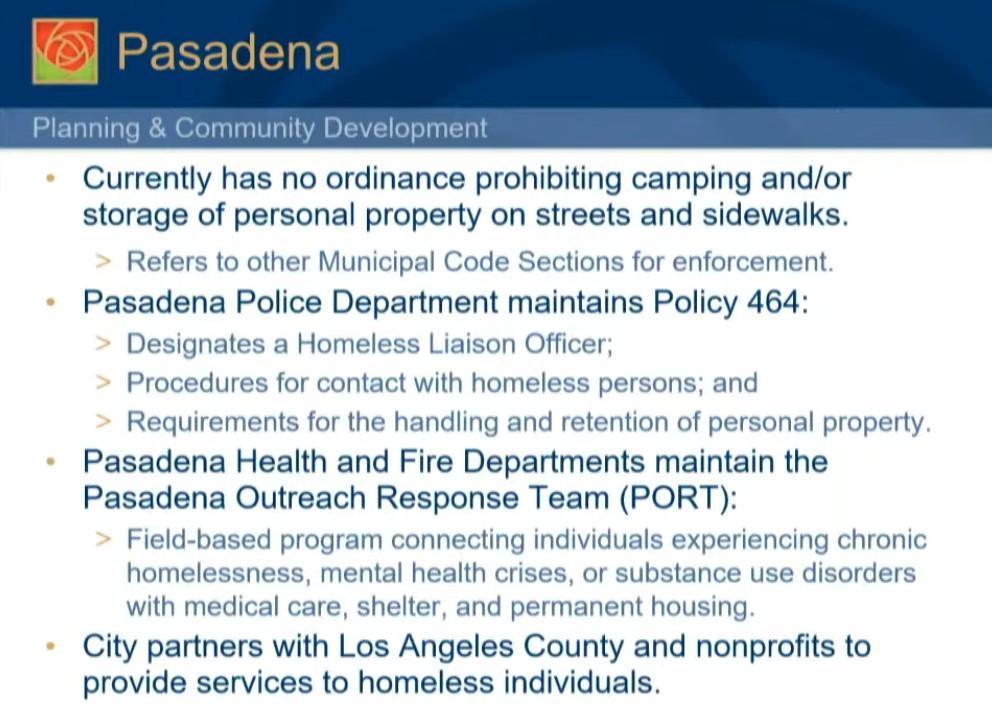
The City of Pasadena does not have an ordinance that specifically prohibits the
camping and storage of personal property on public land and rights-of-way. Rather, the City refers to other sections of the Municipal Code that address general issues such as loitering in parks and the blocking of sidewalks. Additionally, the Pasadena Police Department maintains a policy manual including Policy 464 related to homeless persons, including designation of a Homeless Liaison Officer, procedures for contact with homeless persons, and requirements for the handling and retention of personal property. The policy is very similar to the one used by the City of Glendale. Policy 464 is included as Attachment F. The City’s Health and Fire Departments maintain the Pasadena Outreach Response Team (PORT), a field-based program that connects individuals experiencing chronic homelessness, mental health crises, or substance use disorders with medical care, shelter, and permanent housing. Finally, the City partners with Los Angeles County and nonprofit organizations to provide services to homeless persons.
Discussion on current enforcement by HOPE and PORT teams
There was an extended discussion between the committee and representatives from the Pasadena Police Dept (HOPE team) and the Health Dept (PORT team). I have recapped some notes below but the full recording is linked at the end of this post:
- Pasadena Police Dept: Anyone on patrol will respond to calls from the public about unhoused people but they will reach out to the HOPE team and/or go out with a Union Station (USHS) partner
- HOPE is a non-enforcement team, they provide outreach and connection to USHS
- They will carry out enforcement of the municipal code (typically misdemeanor citations) if necessary
- Tents are taken down, ask people to move their belongings if blocking sidewalk
- If no-one is present to claim property, they tag the property, give 72 hours notice, then discard property if its not claimed in 30 days
- PORT Responses: Non-enforcement, focused only on outreach. Currently the PORT team has limited hours, so PPD is responding to encampments or other unhoused concerns when PORT is unavailable (e.g. weekends, evenings)
Administrative citations would further exacerbate economic distress, lead to warrants
Discussions included implementing administrative citations which would require empowering non-sworn personnel, like park liasons, to issue non-criminal civil citations. This would require setting up an ordinance. PORT and HOPE are limited in their availability and this would use non-sworn personnel e.g. park safety specialists.
Unhoused people obviously do not have the means to pay citations and there are already enforcement's happening in Pasadena so it's unclear how more enforcement would have the effect of getting people into housing and will lead to greater economic distress and increased risks of incarceration. As Councilmember Cole said:
"administrative citations get torn up, tossed in the waste basket, and then eventually turn into warrants."
Weighing in on Policies and Resources
The committee passed a purposefully broad motion to direct the staff for next steps:
The motion broadly covered getting staff recommendations on some the following points:
- Look into changing or improving enforcement that we have now, by either passing, amending, revoking etc laws. Two areas that had the most discussion (and seem likely to come back to the committee) for example were the issue of administrative citations and implementing safety zones around schools
- Including State representatives, may require changes in state law or additional state resources
- Reaching out to the County for resources, especially as East Pasadena is mostly unincorporated
- Reaching out to Metro for resources
- Kaiser at Lake and Villa for mental health and addiction services
- Housing and shelter, progress on the year-round shelter (motel vouchers for example)
Progress on the Year-Round Emergency Shelter
As mentioned at the beginning of this post, it is particularly jarring that the committee is revisiting enforcement policies while currently there is nowhere for residents to go unless the bad weather shelter or cooling locations are open. One of the stated priorities of the newly established committee has been the year-round emergency shelter, which seemed to be finally getting serious attention, so it was disappointing that there was not alot of progress reported since last months meeting. However, at the end of the meeting Jennifer Paige, Assistant City Manager, gave a brief update on progress towards the year-round emergency shelter:
- They have convened an inter-departmental team/task force that meets bi-weekly. The team appears to include staff from planning, police, housing, health and public works departments (latter would be involved in building the shelter)
- They have upcoming visits planned at different shelter models including motel conversions, standalone shelters and tiny home villages
- Rick Cole encouraged the team to include service providers and human services commission as early as possible