What Are We Optimizing For?
I spent a day inside the rapidly growing Alpha School network. I've never been more grateful for our utterly average local public school.
When MacKenzie Price opened her first Alpha School in Texas in 2014 it was out of a desire to better meet her own children’s needs. Her daughters complained to her that school was boring, and so Price got to work, reimagining what the school day could look like. She wondered if the less-fun content of math and language arts could be delivered in a more efficient way (AI-guided instruction on the computer), and free up time for other more engaging stuff, like cooking, rock climbing, and juggling. Now Alpha Schools are booming, cropping up in major cities around the United States, from New York City to San Francisco, with annual tuition of up to $75,000.
So far the Alpha Schools model is primarily available as a costly private school, but the winds of change are howling. Alpha is selling some of their proprietary tech to public schools who can then attempt a pared down version of the Alpha private school experience. US Secretary of Education Linda McMahon and I have both visited Alpha Schools (she went to Texas, I saw a newer campus in California) and I’ll echo her words in saying, we were “blown away” and we’re just “trying to take it all in.” Linda McMahon also said later in a press release, “harnessing AI thoughtfully will be critical to expanding opportunity and preparing students for tomorrow’s workforce.” I would add, “people like learning from people, so let’s not lose sight of that.”
Nevertheless, I was glad Secretary McMahon used the word “thoughtfully” because my greatest concern during my Alpha School visit was that they are painting too broadly with an AI-enabled paintbrush, so to speak. Some things are simply worse with AI and I’ll provide learning how to write as a case in point.
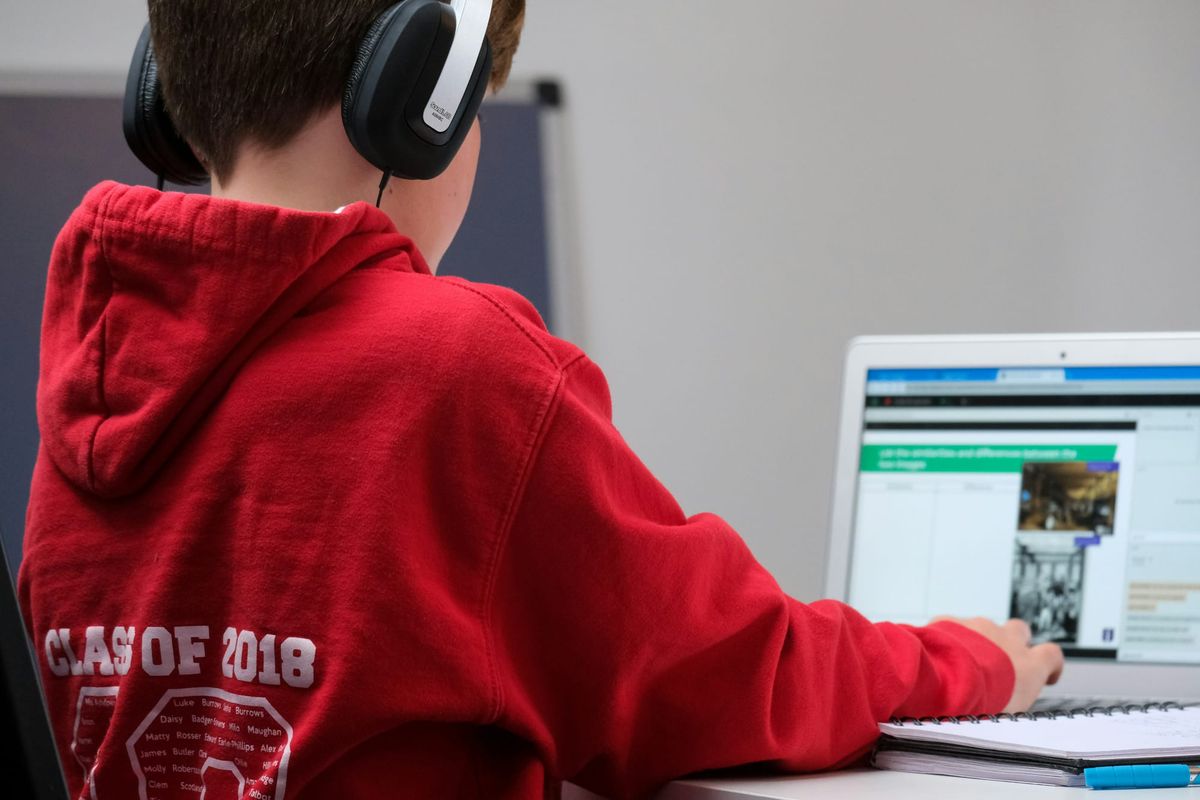
Alpha Schools and public schools across our nation seem to largely agree that there is an advantage to the act of writing, by hand, on paper. The solution in an Alpha School is to have kids use a stylus to write on an iPad with an overlay that simulates the feel of paper (the proprietary Alpha app for handwriting is not yet fully built, so I saw virtually no writing beyond a bit of cursive practice on the day I was there). The public school solution is to use paper and pencil, which is readily and cheaply available to everyone. I will go out on a limb and suggest the best technology for learning the formation of letters all the way to the composition of sentences and paragraphs is pencil and paper. But what about instant feedback? What about earning points to win prizes? You’re right an app might help with that, but at what cost? I’m no fuddy-duddy about technology and happily acknowledge that AI can help improve your writing, once you know how to write. It can write coherent paragraphs and even compelling stories with mere prompts from a human who already knows something about good writing. Here’s the danger: put these tools in the hands of someone who doesn’t know how to write yet and doesn’t have the discernment for quality, and you end up with trite, voiceless, circuitous writing. We don’t have the longitudinal data yet, but my hypothesis is that young people who have only learned to prompt AI and never composed their own writing will have a harder time evaluating the quality of writing and their overall thinking and communication abilities will be weaker. It strikes me as a risky experiment, but a risk Alpha Schools is willing to take.
The experience I was most “blown away” by during my visit was during the life skills portion of the day. I had the special opportunity of sitting with each of the learners in the K-2 “Learning Lab” classroom. Their task was to read a book they’d written, as a rehearsal for the reading they would soon do for an audience of parents. My task was to provide feedback on fluency and volume. They would then re-state the feedback to me as a way of confirming they understood what they were working on. That was all excellent. But the snag came when I sat down with the first student who immediately clarified to me that he had not written this book but actually he just typed in the computer and AI wrote it. This child was cheated out of the opportunity to learn how to write. It might as well have been an older sister who wrote the book for him and told him to pass it off as his own. Of course learning to write is hard but that’s what makes it so good. Done well, it is also a social process of sharing ideas, committing those ideas to paper and then refining those ideas. Take this piece of writing, for example: it was inspired and informed by four or five different conversations with humans that happened after the Alpha visit day. Then I thought about it and reworked it in my mind over the course of a week or more. I wrote and revised multiple drafts. It was slow but my thinking is far clearer than when I started. There is no effective computer program or AI chatbot that will teach you how to write (if there was, Alpha School would certainly be using it) or how to improve your thinking. But even if it did exist, I think I would still choose for my children to learn from a human. After all, we’re generally happier and healthier after spending time with humans and maybe that’s something to optimize for: living the good life, together.
As far as I can tell, Alpha Schools are optimized for learning “boring” stuff as quickly as possible so students can get on to the fun stuff with humans in the afternoons. So it seems we agree that interacting with humans is more fun. A critical problem for Alpha Schools is that a lot of that “boring” stuff has to be learned slowly (like writing) and is best learned with humans. At least that’s what I think. That’s why I’ll keep sending my kids to our local school where they learn the dull stuff and the fun stuff, while interacting with their goofy, brilliant, complex classmates and teachers all day long. What an education!
Note: This opinion piece was written entirely without the assistance of artificial intelligence. Any bad links or typos are entirely my own.
Aside: Boredom might not be the enemy MacKenzie Price thinks it is.