No Kings protest draws record crowds in the U.S. and abroad
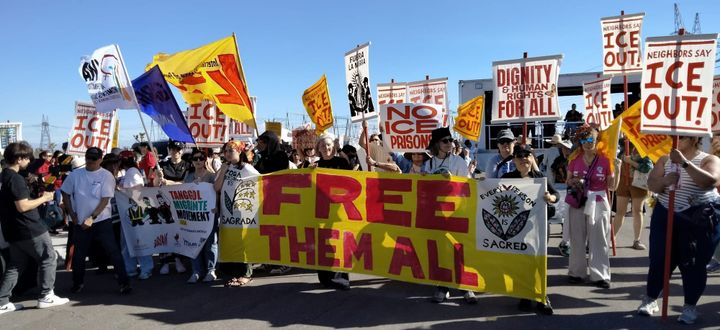
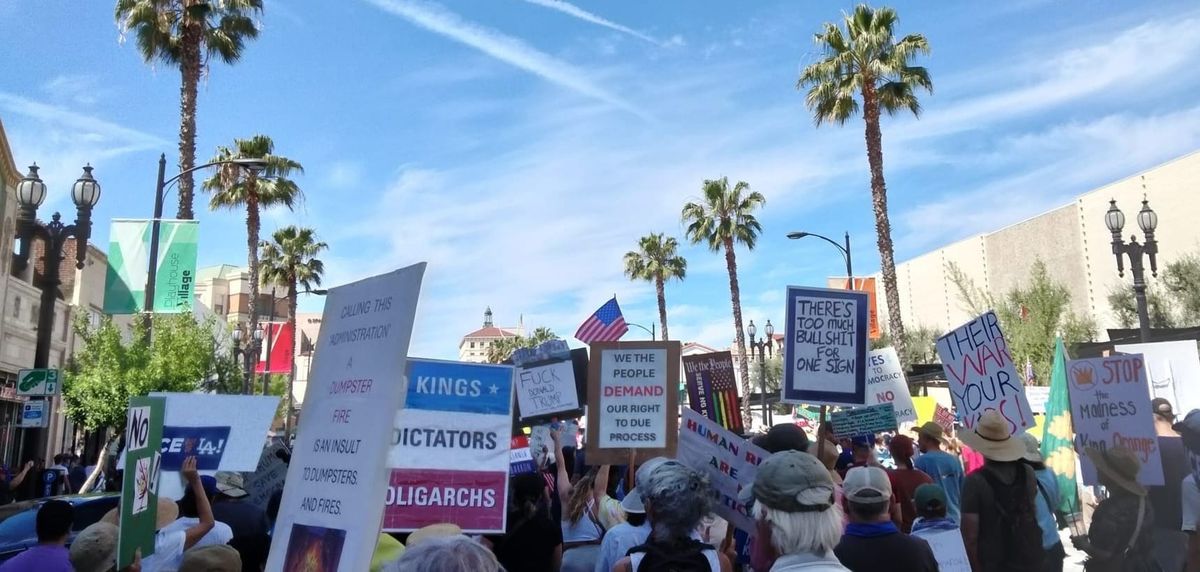
Organizers have estimated that the March 28th protest directed by Indivisible was the largest, nationwide protest in U.S. history. Drawing over 8 million protestors who took to the streets, there were more than 3,300 events across all 50 states. That’s over 500 more events than last October’s protest and nearly twice as many protesters as the first two rallies combined.
Of course, big cities like New York, Boston, Los Angeles, and Minneapolis (which hosted the flagship protest) saw huge turnout. However according to PBS News, protest organizers said two-thirds of RSVPs for the rallies came from outside of major urban centers. That included historically conservative communities in states like Idaho, Wyoming, Montana, Utah, South Dakota and Louisiana.
What’s more, Ezra Levin, co-executive director of Indivisible, said a dozen cities in Europe, Latin America and Australia joined in solidarity to protest Trump and the MAGA agenda. People in countries with constitutional monarchies called the protests “No Tyrants”.
Pasadena Protest
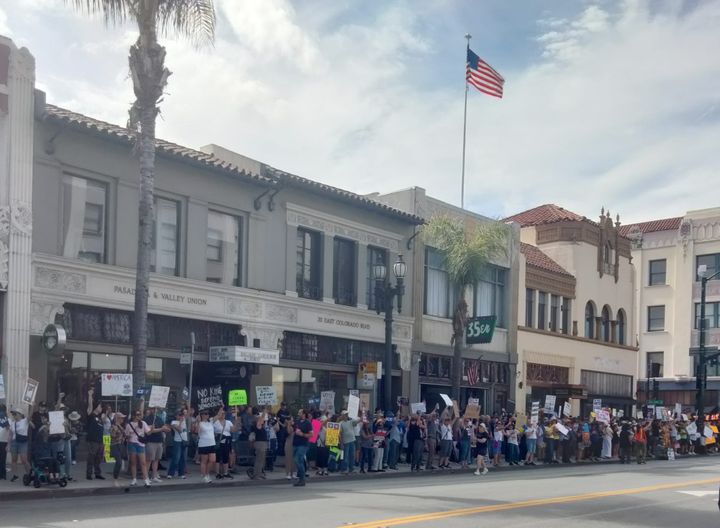
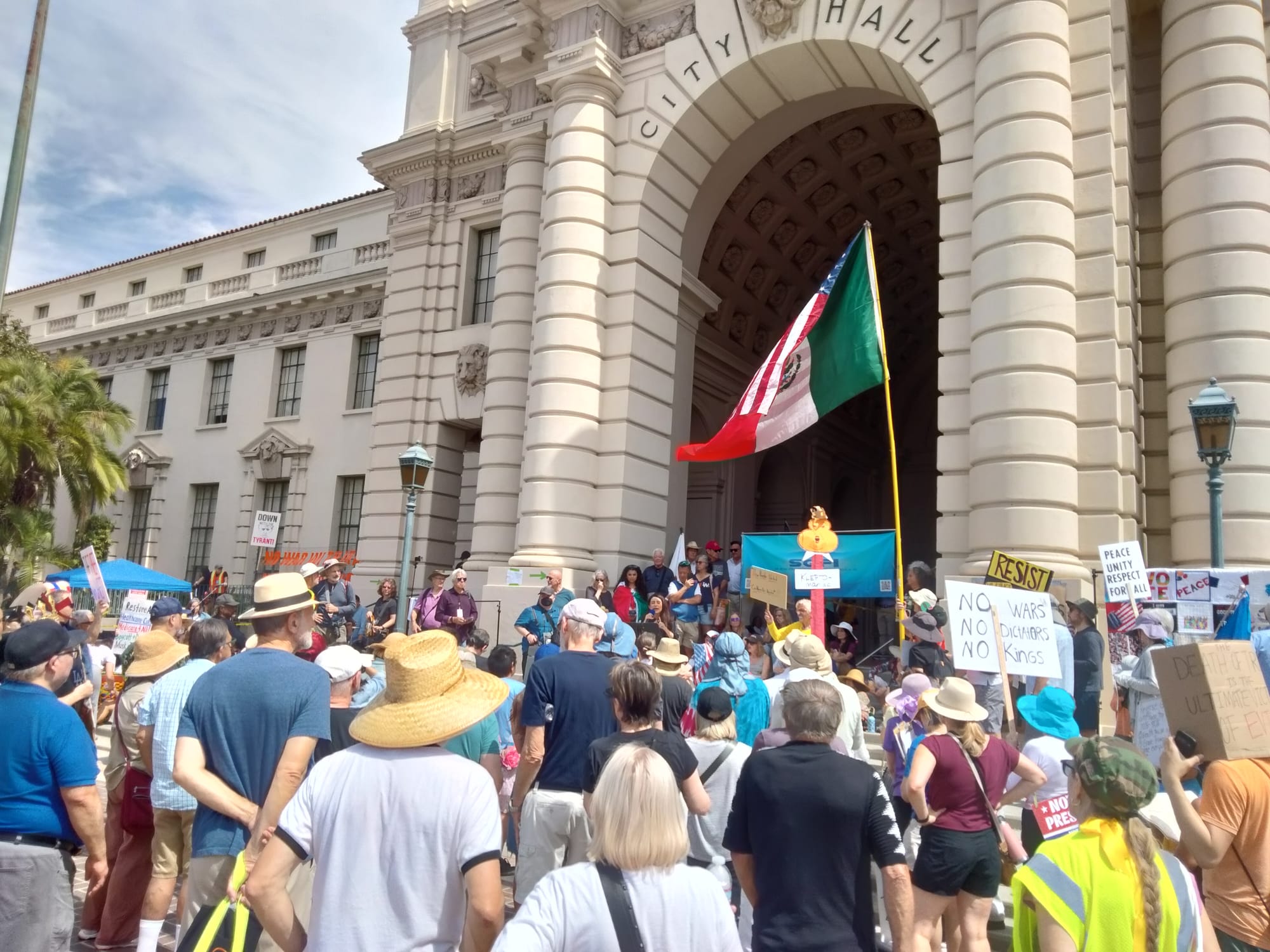
According to ColoradoBoulevard.net, an estimated 8,000 people came together to protest a long list of grievances including the war in Iran, racism, high gas prices, voter suppression, illegal ICE crackdowns, rollbacks on transgender rights and authoritarianism. The No Kings event began late morning at Pasadena City College and from there, thousands marched nearly 2 miles in 90-degree heat to Pasadena City Hall to hear live music and speakers such as U.S. Representative Judy Chu, Pasadena Mayor Victor Gordo, California State Senator Sasha Renee Perez and San Gabriel Foothills Indivisible rally organizers. Alta-Pasadena Indivisible leaders joined the protest and also volunteered as safety monitors. Like all other No Kings protests in Pasadena, it was a joyous, non-violent celebration of democracy and First Amendment rights.
Why these protests are so critical
With an important California Governor race and mid-term elections on the horizon, it’s vital that we keep demonstrating our resolve against this lawless, fascist-leaning regime running our country into the ground. Visuals of millions of people protesting can be emotionally supportive during these dark, disturbing times and encourage people to get out to vote BLUE.
No surprise, GOP officials try to play down the protests’ impact by implying no one cares except the liberal press covering these events. But consider this: The Conservative Political Action Conference (CPAC) held in Texas the same weekend as the No Kings march, saw a dramatic slump in attendance. A significant number of empty seats were on display in the main ballroom and the lack of energy was obvious. Most embarrassing was when Matt Schlapp, a Trump loyalist, asked the sparse crowd “Who wants to see impeachment hearings?” The response was LOUD CHEERS! (That awkward moment has been viewed over 2 million times on X). For the first time in a decade, Trump didn’t attend this latest CPAC confab. Could be because his poll numbers are tanking and his usually adoring crowds are finally getting fed up.
Join the general strike on May 1, 2026
During the flagship No Kings protest in Minneapolis, Ezra Levin, co-founder of Indivisible, issued a call for a general strike on May 1, 2026.
“The next major national action of this movement is not just going to be another protest,” Levin announced to the tens of thousands protesting. “It is a tactical escalation…an economic show of force.”
The call for action on May Day—International Workers’ Day—is being organized under the banner of the “May Day Strong” coalition with the demand of “No Work, No School, No Shopping.”
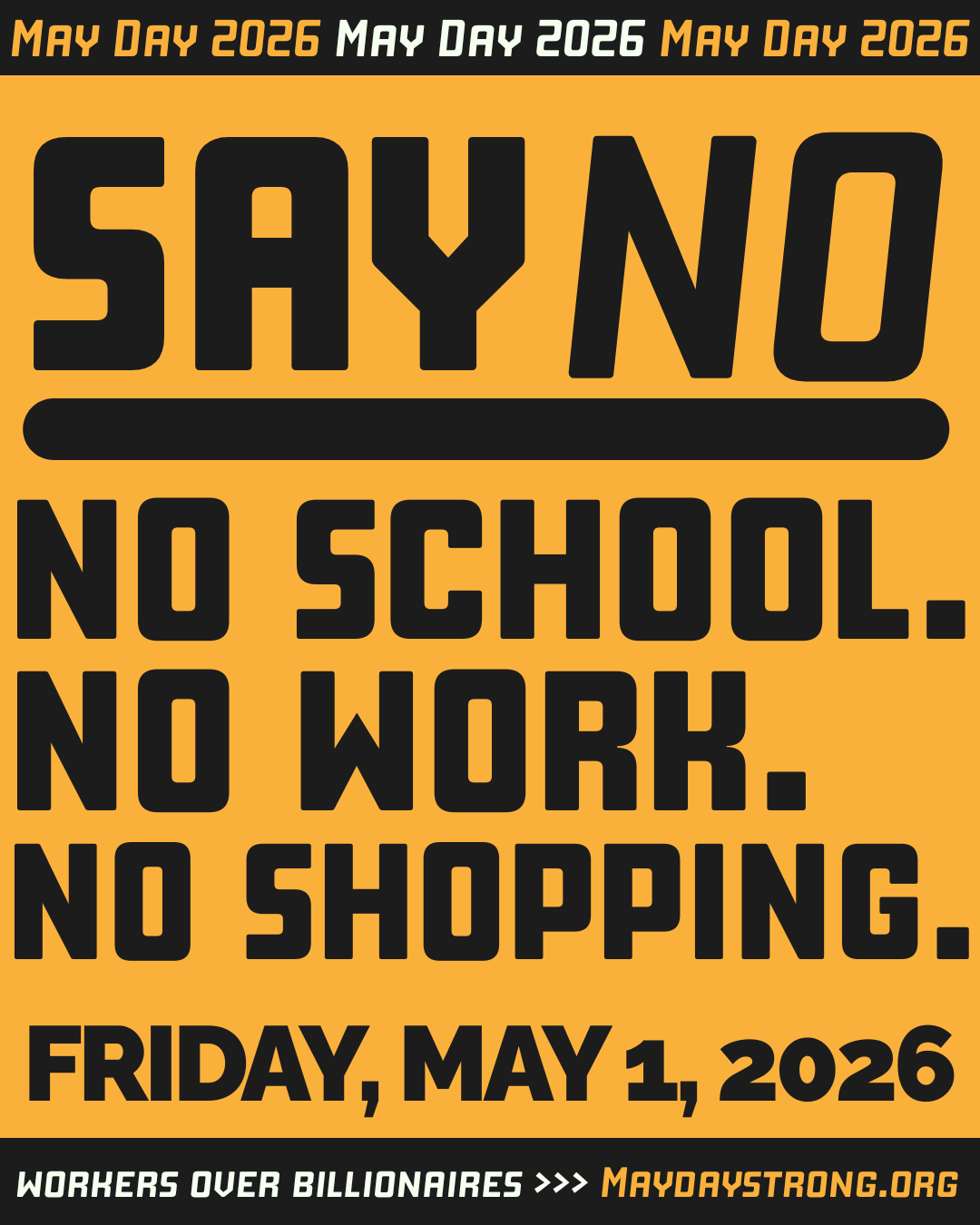
The goal is to create economic pain for those that sustain and profit from the current administration’s agenda and to demand a nation that prioritizes workers over billionaires. The focus is on these three key issues:
- Tax the rich – So our families come first, not billionaire fortunes
- No ICE. No war – No private army serving authoritarian power
- Hands off our vote – No election tampering, voter suppression or intimidation at the polls
Minnesota led the way
The inspiration for this national walkout is rooted in the recent Minnesota General Strike which took place last January. Minneapolis residents and workers launched a citywide general strike to protest the brutality of federal immigration enforcement. Over 100,000 people marched and hundreds of businesses closed. This strike forced a partial retreat of federal ICE and border patrol agents from the state. Proving once again that work stoppage remains one of the most powerful tools of the working class.
Pasadena NOW covers our concerns over data centers.
Pasadena city officials are beginning discussions on whether to allow data centers as a new land use in Pasadena, where such facilities are not necessarily permitted under the zoning code.
Bill Kelly, one of our Alta-Pasadena leaders, submitted a letter, signed by several residents, documenting the many safety risks of data centers to a meeting of Pasadena's Housing, Homelessness and Planning Committee. His thoroughly documented letter, cited a broad range of environmental concerns ranging from increased greenhouse gas emissions, strain on water resources to potential catastrophic accidents.
You can read the Pasadena Now article here and keep an eye out for an accompanying blog post from Bill.
Critical California Governor Race
This could be the most important gubernatorial race in California history. There are two things at play here that can affect the outcome:
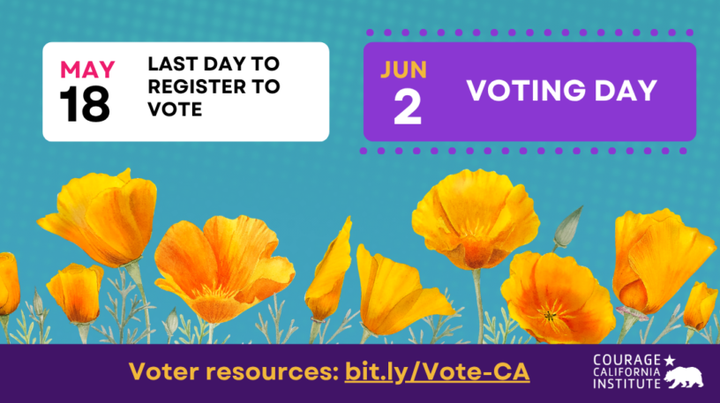
- Our gubernatorial primary election, which takes place on June 2nd, is considered an open all-party primary which means voters are allowed to vote for any candidate from any political party.
- Only the top two candidates who have the most votes coming out of the primary move on to the general election. These two winners could come from the same party.
The problem for California is that there are 60 certified candidates! 24 are Democrats, 12 are Republicans, one Libertarian, one Peace & Freedom and the rest are No Party Preference. So, there’s a distinct chance lower polling candidates could siphon off enough votes and two Republicans could move on to the general election.
Adding to that chaos, one of the top Democrat candidates, Eric Swalwell, was recently hit by credible sexual harassment and assault complaints by former staffers. Now, prominent campaign endorsers like Senator Adam Schiff are pulling their support and campaign staffers are quitting in droves. Many party leaders, such as Schiff and Rep. Nancy Pelosi, are calling for Swalwell to drop out of the race.
Here’s a list of the top polling candidates so far, according to a poll conducted mid-March by the University of California Berkeley Institute of Governmental Studies:
- Steve Hilton, Republican: 17% Fox News contributor and former adviser to conservative British prime minister David Cameron;
- Chad Bianco, Republican: 16% Riverside County Sheriff;
- Don’t Know/Someone else: 16% Those polled either hadn’t made a decision or don’t like the field;
- Katie Porter, Democrat: 13% Former U.S. representative from Orange County;
- Eric Swalwell, Democrat: 13% Current U.S. representative from the Bay Area;
- Tom Steyer, Democrat: 10% Billionaire entrepreneur and former presidential candidate;
- Xavier Becerra, Democrat: 5% Former U.S. Health and Human Services secretary and former California Attorney General;
- Matt Mahan, Democrat: 4% Current mayor of San Jose;
- Antonio Villaraigosa, Democrat: 4% Former mayor of Los Angeles and former Assembly Speaker;
- Betty Yee, Democrat: 1% Former state controller; and
- Tony Thurmond, Democrat: 1% Current state superintendent of public instruction.
Now you can see the difficulty Democrats face.
With so many candidates in the running, 16% of voters either undecided or wanting someone else, and low polling candidates siphoning off votes, we could end up with Hilton and Bianco as the only candidates in the general. And neither Hilton or Bianco would be good options for California. They are too beholden to Donald Trump and the MAGA agenda. If they’re elected, access to healthcare, reproductive rights, immigration rights, and voter rights are all at serious risk.
The California Democratic party has asked the lower polling candidates to drop out, but so far, no one is budging.
How can we ensure a Democrat advances to the general election?
A working group of Indivisible leaders from across California came together to explore exactly that. To better understand where engaged voters stand, they conducted a rapid-response survey with over 11,800 participants using a STAR (0-5 rating) method. The survey results, shown below, were released just a day ahead of the allegations of sexual assault by Swalwell becoming public.
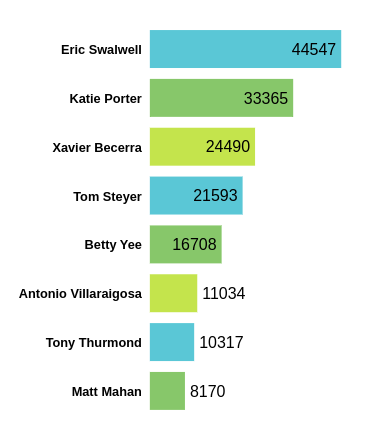
The results suggest a clear grouping of candidates:
- Top tier candidates: Eric Swalwell**, Katie Porter, Xavier Becerra, and Tom Steyer; and
- Lower tier candidates: Betty Yee, Antonio Villaraigosa, Tony Thurmond, and Matt Mahan.
Based on the above results, the working group is calling for Indivisible CA members to contact the lower tier candidates, express appreciation for their service and respectfully ask them to suspend their campaigns by April 15th in light of vote-splitting concerns.
Here's how to contact them:
- Matt Mahan - info@MahanforCalifornia.com
- Tony Thurmond - info@tonythurmond.com
- Antonio Villaraigosa - contact@antonio2026.com
- Betty Yee - info@bettyyee.com
The CA Governors Working Group has also developed Candidate Profiles, which you can access at the link below
Don’t miss the candidate debate on CNN, May 5, 6 pm Pacific Time.
This could be our only opportunity to see how the candidates stack up against one another. To qualify for the CNN debate, eligible candidates must have at least 3% support (or an average of 3%) among likely primary voters in two polls whose methodology meets CNN’s standards for reporting, and must have raised, contributed or loaned at least $1 million for their campaigns.
We are currently researching the candidates and are going to give you as much insight into them as we can so you can make the most informed decision before the June 2 primary.
We’d also like to better understand what your real concerns are about the mid-term elections coming in November. Worried about voter suppression? High prices? Access to healthcare? LGBTQ issues? The erosion of our democracy? The more we understand how our members are feeling, the more effective our group can be in supporting you. Stay tuned for both.